
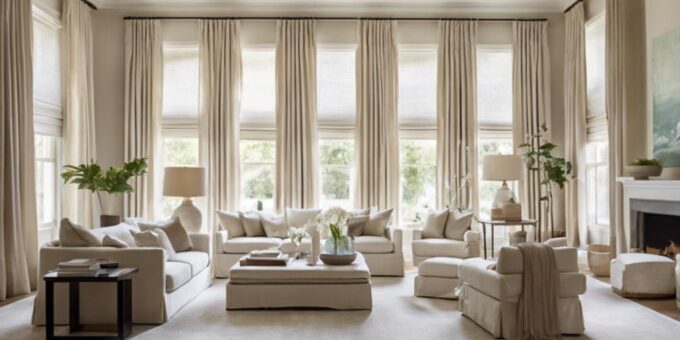
Choosing the right window treatments can greatly impact the aesthetic, functionality, and energy efficiency of your home. To make an informed decision, assess your window treatment needs by considering room-specific requirements, lifestyle factors, and material types. Evaluate the ideal opacity level, measure for proper fitment, and balance functionality with style. Establish a realistic budget and research options to allocate resources effectively. By considering these factors, you’ll be well on your way to selecting the perfect window treatments for your home. Take the next step to discover the perfect solution that meets your unique needs and enhances your living space. Explore different textures, patterns, and designs to find a style that complements your décor while providing the desired level of privacy and light control. Selecting the perfect color palette for your home will help create a cohesive look that enhances each room’s ambiance. With careful planning and attention to detail, you can achieve stylish and functional window treatments that elevate your living space.
Assessing Your Window Treatment Needs
Before selecting window treatments, it's essential to evaluate the specific requirements of each room in your home, considering factors such as natural light, privacy, and energy efficiency. By doing so, you can create a comfortable and functional living space that meets your needs and enhances your overall well-being.
Assessing your window treatment needs involves identifying the unique characteristics of each room, including the direction of sunlight, window size, and architectural style. For instance, south-facing windows require more substantial treatments to filter intense sunlight, while north-facing windows may benefit from lighter treatments to maximize natural light. Additionally, consider the room's purpose and occupancy to determine the level of privacy and noise reduction required.
Understanding Room-Specific Requirements
When choosing window treatments, it's crucial to take into account the unique requirements of each room in your home. Different rooms have varying needs for natural light control and daytime privacy, which affect the functionality and aesthetic of your window treatments. By recognizing these room-specific requirements, you can select the most suitable window treatments to enhance the ambiance and functionality of each space.
Natural Light Control
Effective natural light control involves understanding the unique requirements of each room in your home, where factors such as room orientation, window size, and intended use influence the amount of natural light needed. A well-designed window treatment should balance the need for natural light with the need for privacy and glare control.
To achieve ideal natural light control, consider the following room-specific factors:
- *Room orientation*: Rooms with southern or western exposures typically require more light control due to intense sunlight.
- *Window size*: Larger windows allow more natural light, but may require more extensive light control measures.
- *Intended use*: Rooms used during the day, such as home offices or living rooms, may require more natural light than rooms used at night, like bedrooms.
- *Task-specific lighting*: Areas requiring focused lighting, like reading nooks or kitchen islands, may benefit from layered lighting solutions.
Daytime Privacy Needs
In balancing natural light control with privacy considerations, it's equally crucial to take into account the daytime privacy needs of each room, as they can greatly influence the overall ambiance and functionality of the space. Different rooms have unique requirements for privacy, and understanding these needs will help you choose the most suitable window treatments.
| Room | Daytime Privacy Needs |
|---|---|
| Bedroom | High privacy required to maintain intimacy and relaxation |
| Living Room | Moderate privacy needed to balance natural light and outside views |
| Home Office | High privacy necessary to minimize distractions and maintain focus |
Consider the table above, which highlights the varying daytime privacy needs of different rooms. For instance, bedrooms require high privacy to maintain intimacy and relaxation, while living rooms need moderate privacy to balance natural light and outside views. Home offices, on the other hand, require high privacy to minimize distractions and maintain focus. By understanding the specific privacy needs of each room, you can select window treatments that cater to these requirements, ensuring a comfortable and functional living space.
Considering Your Lifestyle Factors
Your lifestyle factors should be taken into account when selecting the best window treatments for your home. The way you live and use your space can greatly impact the functionality and effectiveness of your window treatments. For example, if you have young children or pets, you may want to think about window treatments that are easy to clean and resistant to damage.
When reflecting on your lifestyle factors, ask yourself:
- Are you a morning person who likes to wake up with natural light, or do you prefer to sleep in and need blackout shades?
- Do you work from home and need a distraction-free environment, or do you entertain frequently and want to showcase your views?
- Are you an avid gardener who wants to highlight your outdoor space, or do you live in a densely populated area and need added privacy?
- Do you have allergies or sensitivities that necessitate specific materials or filtration systems?
Choosing the Right Material Type
Generally, the type of material chosen for window treatments greatly influences their overall performance, durability, and aesthetic appeal. The right material can enhance the functionality and style of your windows, while the wrong one can compromise both. When selecting a material, consider factors such as durability, maintenance requirements, and UV resistance.
Fabric is a popular choice for window treatments, offering a range of styles, textures, and colors. Cotton, linen, and silk are popular fabric options, each with its own unique characteristics. Faux wood and real wood are also popular, offering a natural, warm aesthetic. Vinyl and aluminum are durable, low-maintenance options suitable for high-traffic areas. Consider the functional and aesthetic requirements of your space when selecting a material. For example, if you prioritize energy efficiency, consider a material with thermal insulation properties. By choosing the right material, you can create a harmonious balance between form and function in your home.
Selecting the Ideal Opacity Level
When selecting window treatments, the importance of the opacity level is a vital consideration, as it directly impacts the amount of natural light that enters the room. The ideal opacity level depends on the desired level of privacy, glare control, and ambiance. From sheer to opaque, the choice of opacity level will greatly influence the overall aesthetic and functionality of the space.
Sheer Versus Opaque Options
In the domain of window treatments, the opacity level of a chosen treatment can greatly impact the ambiance and functionality of a room, making it essential to evaluate the benefits of sheer versus opaque options.
When selecting the ideal opacity level for your window treatment, it is important to take into account the specific needs of the room and its occupants. Sheer options, such as light-filtering shades or curtains, allow natural light to enter the room while maintaining a level of privacy. On the other hand, opaque options, like blackout shades or heavy drapery, provide complete darkness and privacy.
- Sheer options provide soft, diffused light and maintain a sense of connection to the outdoors
- Opaque options offer complete darkness, ideal for media rooms or bedrooms
- Sheer options can create a sense of airiness and make rooms appear larger
- Opaque options provide maximum privacy and can help regulate room temperature
Filtering Natural Light Levels
As the opacity level of a window treatment greatly influences the ambiance and functionality of a room, selecting the ideal opacity level to filter natural light becomes a critical decision. The right level of opacity can enhance the aesthetic appeal of a room, improve energy efficiency, and even impact the overall mood of its occupants.
When selecting the ideal opacity level, consider the room's purpose and the desired level of natural light. For instance, a bedroom may require a higher opacity level to guarantee a restful sleep, while a living room may benefit from a lower opacity level to allow for more natural light. Additionally, consider the time of day and the direction of the sun. Eastern and western windows typically require a lower opacity level, as the sun rises and sets at a lower angle. Southern windows, on the other hand, may necessitate a higher opacity level to filter out intense midday sun. By carefully considering these factors, you can choose the ideal opacity level to filter natural light and create a comfortable, inviting space.
Blocking Out Harsh Rays
By selecting an opacity level that effectively blocks out harsh rays, homeowners can create a comfortable atmosphere and reduce the risk of furniture and carpet fading. This is especially important in rooms that receive direct sunlight for extended periods, as it can lead to premature aging of interior decorations. When choosing the ideal opacity level, it's essential to take into account the room's purpose, the amount of natural light desired, and the type of window treatment.
Some key considerations for blocking out harsh rays include:
- Light-blocking shades: Ideal for bedrooms and media rooms, these shades can block out up to 99% of UV rays.
- Sun-filtering shades: Suitable for living rooms and kitchens, these shades filter out harsh rays while still allowing natural light to enter.
- Cellular shades: These shades provide insulation and can block out UV rays, making them perfect for rooms that require energy efficiency.
- Blackout curtains: Designed for complete darkness, these curtains are ideal for home theaters, nurseries, and bedrooms.
Measuring for Proper Fitment
Precise measurements are crucial to guaranteeing an exact fit for your window treatments, as even a slight miscalculation can lead to functional and aesthetic issues. To measure accurately, start by recording the width of your window at three points: the top, middle, and bottom. Take note of any obstructions, such as molding or handles, that may impact the fit of your treatment.
Next, measure the length of your window, making sure to capture the entire area you wish to cover. For inside-mounted treatments, take the measurement from the inside of the window recess. For outside-mounted treatments, measure from the outermost point of the window frame.
When measuring for vertical treatments, such as curtains or drapes, consider the length from the top of the window to the desired length. For horizontal treatments, like blinds or shades, measure the width from side to side. Always double-check your measurements to guarantee an accurate fit, and consider consulting a professional if you're unsure. By taking precise measurements, you'll ensure a seamless installation and a beautiful finish.
Balancing Functionality and Style
When selecting window treatments, homeowners must strike a delicate balance between functionality and style to create a harmonious and effective solution that meets their needs and complements their interior design. This balance is essential, as window treatments not only serve a functional purpose, such as controlling light and privacy, but also contribute to the aesthetic appeal of a room.
To achieve this balance, consider the following key factors:
- Functionality: Consider the room's purpose, the amount of natural light desired, and the level of privacy required.
- Personal style: Think about the overall aesthetic you want to achieve, including the color scheme, texture, and pattern.
- Practicality: Choose materials and designs that are easy to clean, maintain, and operate.
- Resale value: Select window treatments that will appeal to potential buyers if you plan to sell your home in the future.
Budgeting for Your Window Treatments
Determining a budget for window treatments is an important step in the selection process, as it helps homeowners prioritize their needs and allocate resources effectively. By setting a realistic budget, you can focus on finding window treatments that meet your functional and aesthetic requirements without overspending.
When establishing a budget, consider the type of window treatments you need, the size of your windows, and the materials you prefer. For instance, if you have large windows or require custom-made treatments, your budget may need to be higher. Additionally, consider the long-term benefits of investing in high-quality window treatments, such as energy efficiency and durability, which can lead to cost savings over time.
To create a realistic budget, research different window treatment options, and get quotes from suppliers or contractors. Compare prices, considering factors like quality, functionality, and warranty. A well-planned budget will make sure you find the perfect window treatments for your home, meeting your needs and staying within your financial means.
Frequently Asked Questions
Can I Mix and Match Different Window Treatment Styles in One Room?
The art of harmonious coexistence: can disparate window treatment styles converge in perfect harmony within a single room? Absolutely, with intention and finesse. By thoughtfully balancing textures, colors, and opacity levels, you can create a visually appealing ensemble. For instance, pairing flowing drapes with sleek blinds or Roman shades with plantation shutters can add depth and visual interest to the space, yielding a sophisticated, curated look.
How Do I Clean and Maintain My Window Treatments Effectively?
Effective cleaning and maintenance of window treatments are essential to extend their lifespan and preserve their aesthetic appeal. Dust and vacuum window treatments regularly to prevent dirt accumulation. For fabric-based treatments, gently spot clean stains with a mild detergent and water. Avoid harsh chemicals, abrasive materials, and excessive moisture, which can damage or discolor materials. For more delicate treatments, consider professional cleaning or follow manufacturer guidelines.
Are There Any Eco-Friendly Window Treatment Options Available?
Eco-friendly window treatment options abound, aligning with the growing demand for sustainable living. Bamboo, recycled materials, and organic fabrics are popular choices. Solar shades made from recycled polyester and energy-efficient cellular shades also reduce environmental impact. Moreover, natural fiber shades, such as jute and sisal, promote eco-friendliness. By opting for these eco-conscious alternatives, homeowners can minimize their carbon footprint while maintaining stylish, functional window treatments.
Can I Install Window Treatments Myself or Do I Need a Professional?
When contemplating installation, homeowners have two options: DIY or hiring a professional. While some window treatments, like simple curtains or blinds, can be installed independently, more complex or custom solutions may require expert assistance. Factors to ponder include the treatment's complexity, window size, and personal comfort with DIY projects.
What Are the Benefits of Motorized Window Treatments Over Manual Ones?
Motorized window treatments offer several advantages over manual ones. They provide effortless operation, allowing for convenient control and precise adjustments. Motorized treatments also eliminate the need for cords or chains, enhancing safety and aesthetics. Additionally, they can be integrated with smart home systems, enabling remote control and automation. This results in increased energy efficiency, improved accessibility, and enhanced overall functionality.
