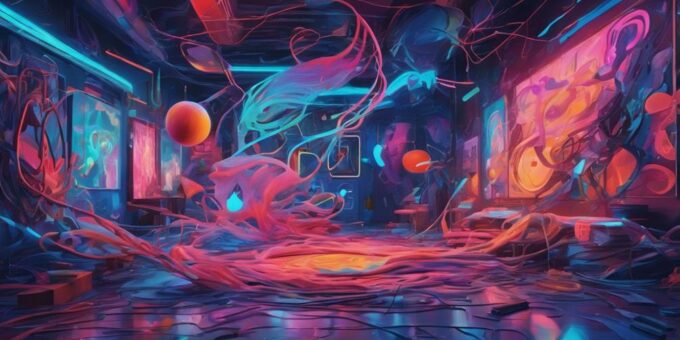
We're witnessing a creative revolution as machines collaborate with humans to generate innovative art, music, and literature. AI-generated art challenges traditional notions of authorship, while human-AI collaboration in design empowers smarter work and pushes boundaries. Interactive installations evoke emotions, and AI-driven music composition generates original tracks. The rise of generative art and algorithmic poetry blurs the lines between human creativity and machine intelligence. As we explore the intersection of AI and creativity, we're discovering new frontiers in art and design. And as we venture further into this uncharted territory, we'll uncover even more surprising possibilities.
AI-Generated Art: A New Era

As we explore the domain of AI-generated art, we're witnessing a seismic shift in the creative landscape, where machines are not only mimicking human imagination but also pushing the boundaries of artistic expression. This new era of art is redefining the way we think about creativity, challenging traditional notions of authorship and ownership. We're no longer bound by the limitations of human skill and experience; instead, we're discovering new possibilities, where machines can generate art that's not only aesthetically pleasing but also emotionally resonant.
As we investigate further into this domain, we're discovering that AI-generated art is not just about replicating human creativity but about augmenting it. We're seeing machines collaborate with humans, generating novel ideas and styles that were previously unimaginable. The results are breathtaking – art that's both familiar and strange, comforting and unsettling. We're forced to confront our biases about what constitutes 'art' and who gets to create it.
We're not just passive observers in this revolution; we're active participants, shaping the trajectory of AI-generated art. We're making deliberate choices about the data we feed these machines, the algorithms we design, and the creative briefs we give them. As we navigate this uncharted territory, we're rewriting the rules of art, expanding the possibilities of human expression, and redefining the role of the artist in the process.
Machines That Learn and Create
We're now witnessing machines that can learn from vast amounts of data, recognize patterns, and create novel artistic expressions that often rival those of humans. These machines are capable of processing vast amounts of information, identifying trends, and generating innovative ideas. By leveraging machine learning algorithms, computers can analyze countless examples of art, music, or literature, and then produce unique creations that blend styles, defy conventions, and push boundaries.
We've seen AI-generated art that mimics the styles of famous painters, from Van Gogh to Picasso. We've heard AI-composed music that echoes the melodies of Bach or Beethoven. And we've read AI-generated literature that rivals the creativity of human authors. These machines are not merely imitating human creativity; they're augmenting it, expanding it, and redefining what we thought was possible.
As we explore the frontiers of machine learning, we're discovering new possibilities for artistic expression. We're creating machines that can learn from human creations, adapt to new inputs, and evolve their own unique styles. The implications are profound: AI-generated art can democratize creativity, making it accessible to anyone with an internet connection. It can also challenge our assumptions about the very nature of creativity, forcing us to reexamine what it means to be human.
Human-AI Collaboration in Design

As we explore the intersection of AI and creativity, we're excited to examine how human-AI collaboration is revolutionizing the design process. By pairing human intuition with AI-driven design assistants, we can expedite innovation and reveal new possibilities. Through co-creative problem solving, we're discovering that the fusion of human and artificial intelligence can lead to truly remarkable designs.
AI-Driven Design Assistants
By 2025, AI-driven design assistants are projected to enhance human designers' capabilities, revolutionizing the creative process through seamless human-AI collaboration. We're on the verge of a design revolution, where AI-driven tools empower us to work smarter, not harder. These intelligent assistants will take care of tedious, time-consuming tasks, freeing us to focus on high-level creative decisions. With AI handling the grunt work, we'll have more time to explore innovative ideas and push the boundaries of what's possible.
We envision a future where AI-driven design assistants help us generate concepts, refine designs, and even predict user behavior. These collaborative tools will learn our design preferences, adapt to our workflows, and provide real-time feedback. We'll work in tandem with AI to create designs that are not only aesthetically pleasing but also functional, sustainable, and accessible. As we leverage the power of AI-driven design assistants, we'll access new levels of creativity, efficiency, and innovation, giving us the edge we need to stay ahead in an increasingly competitive design landscape.
Co-Creative Problem Solving
Through co-creative problem solving, designers and AI systems will engage in a dynamic, iterative process that sparks innovative solutions, as our collective imagination and analytical capabilities converge to tackle complex design challenges. We'll work together, humans and AI, to generate novel ideas, refine concepts, and iterate on designs. This collaborative approach will empower us to address previously insurmountable design problems, revealing new possibilities and pushing the boundaries of what's achievable.
As we co-create, we'll leverage the strengths of both humans and AI:
- Human intuition and creativity: bringing emotional intelligence, empathy, and contextual understanding to the design process
- AI's analytical prowess: processing vast amounts of data, identifying patterns, and optimizing solutions
- Iterative refinement: rapidly prototyping, testing, and refining designs to achieve excellent results
- Augmented decision-making: combining human judgment with AI-driven insights to make informed design decisions
The Rise of Generative Art
We've explored a surge in generative art, a phenomenon where AI algorithms create stunning visuals, music, and even written works, blurring the lines between human creativity and machine intelligence. This intersection of human imagination and machine learning has given birth to a new era of artistic expression. The results are mesmerizing, with AI-generated art that's not only aesthetically pleasing but also thought-provoking.
| Art Form | Generative Capabilities |
|---|---|
| Visual Art | AI-generated paintings, sculptures, and installations that rival human creations |
| Music | Algorithmic compositions that mimic human emotions and complexity |
| Literature | AI-written poetry, novels, and scripts that challenge human authorship |
| Architecture | AI-designed buildings and spaces that redefine urban landscapes |
As we dive deeper into the world of generative art, we're forced to reexamine the very fabric of creativity. Are machines truly creating, or are they simply mimicking human ingenuity? The boundaries are blurring, and we're left to ponder the implications of AI-driven art on our understanding of human creativity. One thing is certain – the rise of generative art has opened up new avenues for artistic exploration, pushing the boundaries of what we thought was possible. As we continue to navigate this uncharted territory, one thing is clear: the future of art has never been more exciting.
Interactive Installations and Emotions

As we explore the intersection of AI and creativity, we're excited to examine the role of interactive installations in evoking emotions. We'll investigate how these immersive experiences can create emotional resonance in physical spaces, and how AI-driven systems can simulate empathy to foster deeper connections. By designing sensory experiences that engage our emotions, we can uncover new ways to inspire and move people.
Emotional Resonance in Space
By immersing ourselves in interactive installations, we can access the emotional resonance of a space, where art, technology, and human experience converge. As we engage with these immersive experiences, we're not just passive observers; we're active participants, influencing the environment and, in turn, being influenced by it. This dynamic interplay reveals a profound emotional resonance, allowing us to connect with the space on a deeper level.
Here are some ways we can harness the emotional resonance of interactive installations:
- Sensory immersion: By engaging our senses, interactive installations can evoke strong emotional responses, from the thrill of excitement to the comfort of serenity.
- Dynamic feedback loops: Real-time feedback enables us to see the impact of our actions, fostering a sense of agency and connection to the space.
- Personalized experiences: Tailored to individual preferences, interactive installations can tap into our unique emotional profiles, amplifying the emotional resonance of the space.
- Collective experiences: Shared interactive installations can create a sense of community, as we come together to co-create an emotional landscape.
Artificial Empathy Engines
In the domain of interactive installations, we're now exploring the boundaries of Artificial Empathy Engines, where cutting-edge AI technology converges with human emotions to create immersive experiences that resonate deeply. By leveraging machine learning algorithms and affective computing, we can craft bespoke emotional journeys that simulate empathy and foster deeper connections between humans and machines. These engines have the potential to revolutionize the way we interact with art, products, and even each other.
We're witnessing the emergence of empathetic interfaces that can detect and respond to our emotional states, creating a new language of emotional intelligence. This fusion of human emotions and AI-driven insights enables the creation of personalized, real-time emotional feedback loops. As we navigate these uncharted territories, we're uncovering new possibilities for emotional expression, catharsis, and healing. The implications are profound – we're on the cusp of a revolution that will redefine the boundaries of human-AI collaboration and artistic expression.
Sensory Experience Design
We craft immersive sensory experiences that evoke emotions, memories, and sensations, blurring the lines between reality and fantasy in interactive installations that envelop and transform us. By combining AI-driven technologies with artistic vision, we create multidimensional environments that awaken the senses and spark new connections. Our interactive installations are designed to evoke emotions, spark curiosity, and challenge perceptions.
Here are some ways we're pushing the boundaries of sensory experience design:
- Emotional Resonance: We use AI-driven sentiment analysis to tailor the experience to individual emotions, creating a deeply personal connection with each participant.
- Sensory Fusion: By combining multiple sensory inputs, such as sound, light, and scent, we create a holistic experience that engages the entire body.
- Dynamic Adaptation: Our installations adapt in real-time to the participant's responses, ensuring a unique and dynamic experience with each interaction.
- Neuroscientific Insights: We're leveraging advances in neuroscientific research to inform our design, ensuring that our installations have a profound impact on the human experience.
AI-Assisted Music Composition
As musicians and composers, we're now tapping into the power of artificial intelligence to generate, manipulate, and refine musical ideas in ways previously unimaginable. With AI-assisted music composition, we're pushing the boundaries of creativity, exploring new sounds, and opening up innovative possibilities. By leveraging machine learning algorithms, we can analyze vast amounts of musical data, identify patterns, and generate novel melodies, harmonies, and rhythms.
| AI-Assisted Music Composition Tools | Capabilities |
|---|---|
| Amper Music | Generates original music tracks in minutes |
| AIVA | Composes orchestral scores for film and video games |
| Jukedeck | Creates custom music for advertisements and videos |
| Flow Machines | Develops AI-generated music for various genres |
| Magenta | Explores the intersection of AI and music creativity |
These cutting-edge tools empower us to experiment with unprecedented speed and precision, freeing us from the constraints of traditional composition methods. We can now focus on the creative vision, while AI handles the technicalities. As a result, we're witnessing a surge in innovative musical collaborations, where humans and machines work in tandem to produce groundbreaking works of art. The possibilities are endless, and we're just beginning to scratch the surface of what's possible when AI meets music.
New Frontiers in Visual Storytelling

As we explore the intersection of AI and creativity, we're excited to venture into the domain of New Frontiers in Visual Storytelling. We're going to examine how AI is transforming the way we tell stories, from immersive augmented reality narratives to innovative visual data storytelling. By harnessing the power of AI, we're pushing the boundaries of what's possible in visual storytelling, and we can't wait to see what's next.
Augmented Reality Narratives
One hundred years after the dawn of cinema, augmented reality narratives are exploring new horizons and rewriting the rules of visual storytelling. We're no longer confined to the limitations of the screen; instead, we're stepping into immersive worlds that blur the lines between reality and fantasy. With AR narratives, we're not just passive observers – we're active participants, influencing the narrative trajectory with every gesture and movement.
As we investigate this new frontier, we're discovering new ways to engage audiences and push the boundaries of storytelling. Here are just a few ways AR narratives are revolutionizing the art form:
- Immersive experiences: AR narratives envelop us in 360-degree worlds, making us feel like we're living the story.
- Interactive storytelling: We're no longer just watching – we're influencing the narrative, making choices that shape the story's outcome.
- Dynamic characters: AR characters come to life, interacting with us in real-time and responding to our actions.
- Ephemeral art: AR narratives can exist in the physical world, leaving behind a trail of digital breadcrumbs that disappear once the experience is over.
Visual Data Storytelling
By harnessing the power of visual data storytelling, we're exploring new frontiers in visual narrative, where intricate information is transformed into engaging, interactive experiences that reveal hidden patterns and insights. This fusion of art and analytics empowers us to communicate complex data in a way that's both intuitive and enthralling. With AI-driven visualization tools, we can distill vast amounts of data into stunning, interactive visuals that tell a story. We're no longer limited by static charts and graphs; instead, we can craft immersive experiences that invite exploration and discovery. By leveraging machine learning algorithms, we can uncover hidden correlations and relationships within the data, revealing new insights that inform our creative decisions. As we push the boundaries of visual data storytelling, we're opening up new opportunities for creative expression and innovation. The intersection of AI and creativity is revolutionizing the way we communicate, and we're at the forefront of this exciting evolution.
Algorithmic Poetry and Literature
We've seen a surge of interest in algorithmic poetry and literature, which leverages machine learning to generate unique, computer-created works that blur the lines between human creativity and artificial intelligence. This innovative approach has opened up new avenues for artistic expression, allowing machines to tap into the domain of language and imagination. As we explore the intersection of AI and creativity, we're discovering that machines can indeed create works that are both thought-provoking and aesthetically pleasing.
Some fascinating aspects of algorithmic poetry and literature include:
- Generative models: These models use machine learning algorithms to generate poetry and literature based on patterns and structures learned from vast amounts of text data.
- Collaborative creativity: Human writers and AI systems can collaborate to produce innovative works that blend the best of both worlds – human intuition and machine-generated ideas.
- Experimentation and innovation: Algorithmic poetry and literature encourage experimentation with language, form, and style, pushing the boundaries of what we consider 'art' and 'literature.'
- Rethinking authorship: As machines take on more creative roles, we're forced to reexamine traditional notions of authorship and the role of human creators in the creative process.
As we explore further into this exciting territory, we're bound to uncover new possibilities for artistic expression and collaboration between humans and machines. The future of algorithmic poetry and literature is bright, and we're excited to see what innovative works will emerge from this intersection of AI and creativity.
AI-Driven Fashion and Textiles

As we explore the world of AI-driven fashion and textiles, machines are redefining the boundaries of style, sustainability, and self-expression. We're witnessing a revolution in the fashion industry, where AI algorithms are being used to design, produce, and distribute clothing. This fusion of technology and fashion is giving rise to innovative materials, patterns, and designs that were previously unimaginable.
We're seeing AI-driven fashion brands emerge, which use machine learning to analyze trends, predict demand, and optimize supply chains. This results in reduced waste, reduced costs, and increased efficiency. Moreover, AI-powered design tools are enabling designers to create complex patterns, shapes, and textures that would be impossible to achieve by human hands alone.
In addition, AI-driven textiles are being developed with enhanced properties, such as self-healing fabrics, water-repellent materials, and even garments that can monitor our vital signs. It's not just about aesthetics; it's about creating clothing that serves a purpose beyond just looking good. We're on the cusp of a fashion revolution, where technology and creativity converge to redefine the very fabric of our industry. As we continue to push the boundaries of what's possible, we're excited to see the innovative and sustainable fashion solutions that AI will bring to the forefront.
The Future of Creative Industries
We’re now positioned to revolutionize the creative industries, where AI’s transformative power will reshape the art, music, and entertainment landscapes. As we stand at the threshold of this new era, we’re ready to unleash unprecedented levels of innovation and creativity. The future of creative industries is not just about incorporating AI tools into our workflows, but about fundamentally redefining the way we create, produce, and engage with art, music, and entertainment. This transformation comes with the crucial need to balance technological advancements with ethical AI and responsibility, ensuring that creativity remains authentic and inclusive. By fostering collaboration between humans and AI, we can create new artistic expressions while maintaining respect for intellectual property and artistic integrity. As we navigate this evolving landscape, prioritizing transparency and fairness will be essential in shaping a future where innovation and ethics coexist harmoniously.
The possibilities are endless, and we're excited to explore the uncharted territories that AI will open up. Here are just a few areas where we can expect to see significant impact:
- AI-generated content: AI algorithms will generate original music, art, and even entire scripts, pushing the boundaries of creative expression.
- Personalized experiences: AI-driven recommendations will enable tailored entertainment experiences, revolutionizing the way we consume music, movies, and art.
- Collaborative workflows: Humans and AI systems will work together to co-create new works of art, music, and literature, blurring the lines between creator and machine.
- New business models: The rise of AI will give birth to novel revenue streams and business models, disrupting traditional industries and creating new opportunities for entrepreneurs and creatives alike.
As we set out on this journey, we're not just witnesses to a revolution – we're the architects of a new creative landscape. The future of creative industries is being rewritten, and we're thrilled to be a part of it.
Frequently Asked Questions
Can Ai-Generated Art Be Considered "Real" Art?
We're not afraid to spark controversy: can art created by machines truly be considered "real" art? We think it's time to redefine what art means in the 21st century. If AI-generated art evokes emotions, inspires, and challenges our perspectives, then yes, it's real art. The creator's identity – human or machine – shouldn't dictate its value. We believe art's power lies in its impact, not its origin.
Will AI Replace Human Designers in the Creative Industry?
We're not convinced AI will fully replace human designers. While AI can process data and generate designs, it lacks our creative intuition and emotional depth. AI can assist, but human designers bring unique perspectives and empathy to projects. We'll work alongside AI, not be replaced by it. The collaboration will elevate our work, not supplant it.
How Can We Ensure Ai-Generated Content Is Original and Not Plagiarized?
We're holding our breath as we venture into the unknown – can AI-generated content truly be original? The million-dollar question: how do we guarantee it's not plagiarized? We're talking about the integrity of art itself. We need to develop robust algorithms that detect and prevent copying, while incentivizing AI to think outside the box. It's a tall order, but we're up for the challenge. After all, the future of creativity depends on it.
Can AI Truly Understand and Replicate Human Emotions in Art?
"We're skeptical about AI truly replicating human emotions in art. While AI can analyze and mimic certain patterns, it lacks the depth of human experience. Emotions are complex, messy, and deeply rooted in our individual experiences. Can AI genuinely convey the anguish of heartbreak or the euphoria of love? We're not convinced. AI-generated art may be impressive, but it's still a simulation, lacking the authenticity and emotional resonance that only human creators can bring."
Will Ai-Driven Creativity Lead to Homogenization of Artistic Styles?
We're concerned that AI-driven creativity might lead to a homogenization of artistic styles. As we rely more on machines to generate art, we risk losing the unique human touch that makes art, well, art. We'll be left with a sea of sameness, devoid of the emotional depth and complexity that human creators bring to the table. It's a frightening thought – will we sacrifice our individuality for the sake of efficiency and convenience?
