
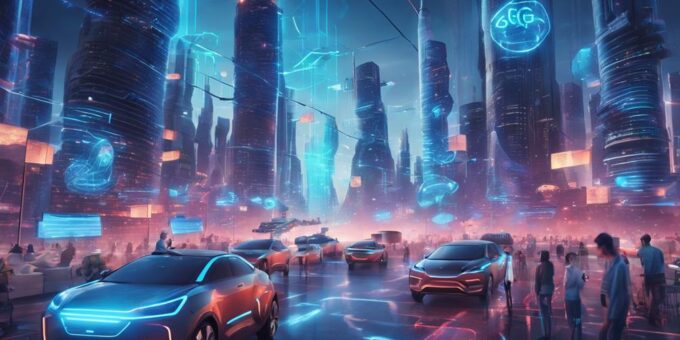
We're now living in a world where 5G networks are capable of delivering speeds of up to 20 Gbps, a staggering 100 times faster than 4G, and this revolutionary leap forward in wireless technology is transforming the way we live, work, and interact with each other. With reduced latency and increased bandwidth, 5G is paving the way for seamless video streaming, online gaming, and virtual reality experiences. But that's not all – 5G is also enabling smart cities, remote healthcare, and immersive entertainment. As we explore the capabilities of 5G, we're just scratching the surface of what's possible.
Understanding the Basics of 5G
As we explore the world of 5G, it's essential to start with the fundamentals: what exactly is 5G, and how does it differ from its predecessors? We've heard the buzz, but let's break it down. In simple terms, 5G is the fifth generation of wireless network technology, designed to provide faster data speeds, lower latency, and greater connectivity than its predecessors. It's not just an incremental upgrade; it's a revolutionary leap forward.
We know that 4G, or LTE, was a significant improvement over 3G, offering faster mobile broadband and paving the way for the widespread adoption of smartphones. But 5G takes it to the next level. With speeds that can reach up to 20 Gbps, 5G is poised to enable a wide range of new and innovative services, from enhanced mobile broadband to mission-critical communications.
One key difference between 5G and its predecessors is its ability to support a vast number of devices. As we move towards a world where everything is connected, 5G's increased capacity and low latency make it the ideal network for the Internet of Things (IoT). We're no longer just talking about smartphones; we're talking about smart homes, smart cities, and smart industries. As we explore further into the world of 5G, it's important that we grasp the basics, and that's exactly what we're doing here.
5G Speed and Capacity Improvements
As we explore the advancements in 5G technology, we're excited to discuss the significant upgrades in speed and capacity. We're now experiencing faster data transfer rates, allowing us to download and upload massive files in a fraction of the time it took with previous networks. With increased bandwidth, we can enjoy seamless video streaming, online gaming, and other data-intensive activities without any lag or buffering.
Faster Data Transfer
We're on the cusp of a data transfer revolution, where blistering speeds and exponentially increased capacity are redefining the possibilities of 5G connectivity. With 5G, we're no longer constricted by the limitations of previous generations. We're talking speeds that can reach up to 20 Gbps, a significant leap from 4G's 100 Mbps. This means we can download movies in seconds, not minutes, and upload large files in the blink of an eye.
But it's not just about speed; it's also about capacity. With 5G, we're witnessing a substantial increase in the number of devices that can be connected to the internet at the same time. This is pivotal for applications like smart cities, where thousands of sensors and devices need to communicate with each other seamlessly. We're also seeing improvements in latency, with 5G reducing it to as low as 1 ms. This means near-instantaneous communication, making it ideal for applications that require real-time feedback, like autonomous vehicles or remote healthcare. With these enhancements, we're opening up new possibilities for industries and individuals alike.
Increased Bandwidth
Higher frequency bands and advanced modulation schemes enable 5G to support unprecedented bandwidth, allowing for a massive influx of devices and data to be transmitted simultaneously. We're no longer limited by the constraints of 4G, where congestion and buffering were the norm. With 5G, we can seamlessly stream high-definition videos, engage in online gaming, and even remotely access complex computing resources – all at the same time. This increased bandwidth also paves the way for the widespread adoption of IoT devices, smart cities, and industrial automation. We can now connect a vast number of devices, from sensors to drones, without worrying about network congestion.
Moreover, the increased bandwidth of 5G allows for improved Quality of Experience (QoE), ensuring that our online interactions are faster, smoother, and more reliable. We can enjoy low-latency communication, reduced lag, and faster data transfer rates. This means that we can now engage in real-time communication, remote healthcare, and immersive entertainment experiences like never before. With 5G, the possibilities are endless, and we're just beginning to scratch the surface of what's possible. As we continue to push the boundaries of 5G, we're excited to see the innovative use cases that will emerge.
Low Latency and Ultra-Reliability
With 5G, latency drops to as little as 1 ms, enabling applications that demand near-instant responses, like autonomous vehicles and smart grids. This low latency is a game-changer, allowing for real-time communication and reaction. We can finally explore the possibilities of mission-critical services, where every millisecond counts. Imagine remote surgeries, where doctors can operate on patients in real-time, or smart manufacturing, where machines can respond instantly to changes in production.
We're not just talking about speed; we're talking about reliability too. 5G's ultra-reliable communications guarantee that critical messages get through, even in the most demanding environments. This is crucial for applications like smart power grids, where a single miscommunication could have catastrophic consequences. With 5G, we can make sure that our energy infrastructure is more resilient and efficient than ever before.
What does this mean for us? We'll see new use cases emerge that were previously unimaginable. Autonomous vehicles, for instance, will be able to react to their surroundings in real-time, making our roads safer and more efficient. Meanwhile, remote healthcare will become more accessible, allowing patients to receive medical consultations from the comfort of their own homes. The possibilities are endless, and we're excited to see how low latency and ultra-reliability will shape the future of 5G.
The Rise of IoT and Smart Cities
As we explore the rise of IoT and smart cities, we're excited to see how 5G's capabilities will revolutionize urban landscapes. We're looking forward to discussing how connected urban infrastructure will enable seamless communication between devices and systems, making our cities more efficient and sustainable. By harnessing 5G's efficient data management, we can reveal new possibilities for smart city initiatives that improve our daily lives.
Connected Urban Infrastructure
Transforming urban landscapes, we're witnessing the convergence of IoT and city infrastructure, where smart traffic management, intelligent energy grids, and data-driven public services are redefining the urban experience. As we move towards connected urban infrastructure, we're seeing a significant shift in how cities operate and interact with citizens. The integration of IoT devices and sensors enables real-time monitoring and optimization of various city functions, making our cities more livable, sustainable, and efficient.
| Smart City Application | Benefits | Example |
|---|---|---|
| Intelligent Traffic Management | Reduced congestion, improved air quality | Smart traffic lights adjusting timings in real-time |
| Energy Efficient Buildings | Energy savings, reduced emissions | Automated lighting and HVAC systems |
| Waste Management | Improved sanitation, reduced waste | Smart waste bins with sensors for efficient collection |
| Public Safety | Enhanced security, reduced crime | IoT-enabled surveillance cameras with AI-powered analytics |
| Healthcare Services | Improved patient care, reduced costs | Remote patient monitoring with IoT-enabled wearables |
As we continue to advance connected urban infrastructure, we're excited to explore the endless possibilities that 5G has to offer. With faster speeds, lower latency, and increased connectivity, the potential for innovation and transformation is vast.
Efficient Data Management
We're generating vast amounts of data through our IoT devices and sensors, which demands a reliable and efficient data management system to fully realize the potential of smart cities. As we continue to connect more devices, the sheer volume of data will only continue to grow. This presents a significant challenge: how do we effectively manage, process, and analyze this data to gain valuable insights?
Effective data management is essential to harness the benefits of IoT and smart cities. We need systems that can handle massive amounts of data in real-time, providing instant insights to inform decision-making. This is where 5G's low latency and high-speed data transfer come into play. With 5G, we can process and analyze data in real-time, enabling us to respond quickly to changing conditions in our cities. This could mean optimizing traffic flow, improving public safety, or enhancing energy efficiency. By leveraging 5G's capabilities, we can create more efficient, sustainable, and livable cities. By doing so, we'll be able to fully tap into the potential of IoT and smart cities, making our lives better and more convenient.
Enhanced Mobile Broadband Experience
With 5G, we're enjoying blazing-fast mobile broadband speeds, allowing us to seamlessly stream high-definition videos and engage in online activities without frustrating lags. This enhanced mobile broadband experience is a game-changer, revolutionizing the way we consume and interact with online content. We can now effortlessly multitask, switching between apps and websites without experiencing buffering or freezing.
The increased bandwidth and lower latency of 5G enable us to enjoy uninterrupted video conferencing, online gaming, and virtual reality experiences. We can also download and upload large files in a fraction of the time it took with 4G, making it ideal for remote work, online collaboration, and cloud-based services. The enhanced mobile broadband experience is also paving the way for new use cases, such as augmented and virtual reality, that were previously limited by slower network speeds.
Furthermore, 5G's enhanced mobile broadband experience is enabling new business models and revenue streams. For instance, mobile operators can now offer premium services, such as high-definition video streaming and online gaming, to differentiate themselves from competitors. As we continue to explore the possibilities of 5G, it's clear that the enhanced mobile broadband experience is just the beginning of a new era in mobile connectivity.
5G Security and Privacy Concerns
As we increasingly rely on 5G's enhanced mobile broadband experience, our personal data and sensitive information are being transmitted at unprecedented speeds, raising critical security and privacy concerns that demand immediate attention. We're no longer just sharing simple text messages or low-res images; we're transmitting high-definition videos, sensitive documents, and even biometric data. This influx of data creates a treasure trove of information for hackers and cybercriminals.
We're not just worried about individual hackers, either. Nation-state actors and organized crime groups are also exploiting 5G's vulnerabilities to steal sensitive information, disrupt critical infrastructure, and even influence global events. The increased use of IoT devices on 5G networks further exacerbates the problem, as these devices often lack robust security features, providing an open door for malicious attacks.
We need to take proactive measures to safeguard our data and privacy. This includes using end-to-end encryption, implementing robust authentication protocols, and conducting regular security audits to identify vulnerabilities. We must also hold service providers and device manufacturers accountable for prioritizing security and privacy in their products and services. By acknowledging these concerns and taking collective action, we can guarantee that 5G's benefits are realized without compromising our digital well-being.
Future Applications and Possibilities
Embracing the potential of 5G, we're positioned to unlock unprecedented possibilities, from remote healthcare and virtual education to smart cities and immersive entertainment, all of which will revolutionize the fabric of our daily lives. As we forge ahead, we'll witness transformative applications that redefine industries and reshape our experiences.
With 5G's low latency and high-speed connectivity, we'll see:
- Remote surgeries becoming the norm: Surgeons will perform complex procedures from anywhere in the world, expanding access to quality healthcare and saving countless lives.
- Interactive, AI-driven education: Students will engage with virtual instructors, exploring immersive, interactive learning environments that make complex concepts more accessible and fun.
- Smart cities that adapt to our needs: Intelligent infrastructure will optimize traffic flow, energy consumption, and public services, creating a more efficient, sustainable urban landscape.
As we explore these new frontiers, we’ll uncover even more innovative applications that harness 5G’s capabilities. The future is bright, and we’re excited to see the incredible possibilities that await us. With faster data speeds and lower latency, 5G will play a crucial role in advancing the future of biotechnology, enabling real-time data analysis and remote medical procedures. This breakthrough will revolutionize healthcare, allowing for more precise diagnostics and personalized treatments. As 5G technology continues to evolve, we can expect it to drive groundbreaking innovations across various industries.
Frequently Asked Questions
Can I Use My 4G Phone on a 5G Network?
'Did you know that 5G networks are expected to cover 65% of the world's population by 2025? Wow! Now, about that question: can we use our 4G phones on a 5G network? The short answer is yes, but with some limitations. Our 4G phones can connect to a 5G network, but we won't get the full 5G experience. We'll still get 4G speeds, not the blazing-fast 5G ones. So, it's time to contemplate upgrading to a 5G-enabled phone to unleash the full potential of 5G!'
Will 5G Replace Wi-Fi in Homes and Offices?
We're wondering if 5G will replace Wi-Fi in homes and offices. Honestly, we don't think so, at least not entirely. While 5G is incredibly fast, it's not designed for local networking like Wi-Fi is. We'll likely use 5G for wide-area connectivity and Wi-Fi for local connections. It's possible we'll see hybrid solutions, but Wi-Fi's convenience and affordability will keep it relevant.
Do All 5G Networks Offer the Same Speed and Performance?
Exploring the 5G landscape is like trying to find the perfect recipe – it takes some trial and error. When it comes to speed and performance, not all 5G networks are created equal. We've found that different carriers offer varying levels of speed and performance, depending on factors like infrastructure and spectrum allocation. Some networks may offer blazing-fast speeds, while others might be more like a slow-cooked meal – still tasty, but not exactly lightning-fast.
Is 5G Available Only in Urban Areas or Everywhere?
We're often asked if 5G is only available in urban areas or everywhere. The truth is, 5G coverage varies depending on your location and provider. While many carriers prioritize urban areas, some are expanding to rural regions. We've seen efforts to bring 5G to smaller towns and cities, but it's still not universally available. We expect to see continued growth and improvement in 5G coverage over time.
Can 5G Be Used for Self-Driving Cars and Autonomous Vehicles?
We're fascinated by the fusion of futuristic tech and fast lanes, wondering if 5G can fuel the future of self-driving cars and autonomous vehicles. The answer is yes! With 5G's low latency and high-speed connectivity, it can enable real-time data exchange between vehicles and infrastructure, paving the way for safer, more efficient autonomous transportation. We're excited to see how 5G will accelerate the adoption of autonomous vehicles, revolutionizing the roads ahead.
