
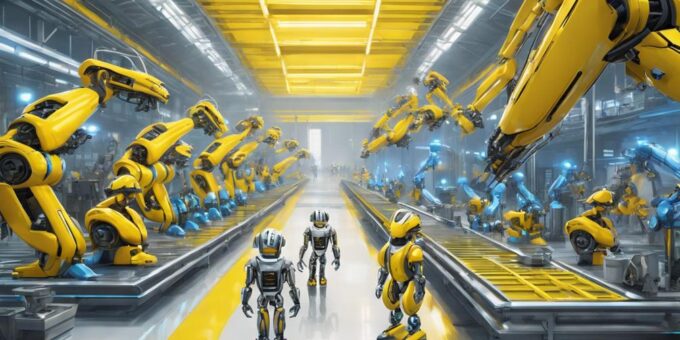
We're witnessing a transformative shift in manufacturing, where robotics is playing a pivotal role in increasing efficiency and safety by automating tasks, minimizing labor costs, and reducing workplace accidents. By incorporating robots, we're freeing up to 30% of production time, reducing labor costs, and minimizing accidents. We're also streamlining production processes, reducing downtime, and increasing efficiency. As we continue to integrate robots into our workflow, we'll uncover even more opportunities to boost productivity, enhance supply chain efficiency, and future-proof our manufacturing operations – and that's just the starting point.
Boosting Productivity With Automation
By automating repetitive and mundane tasks, we can free up to 30% of our production time, allowing us to focus on higher-value tasks that drive innovation and growth. This is a game-changer for our manufacturing processes, as we're no longer bogged down by tedious tasks that take up valuable time and resources. By implementing robotics and automation, we're able to streamline our operations, reduce errors, and increase overall efficiency.
We've seen significant improvements in our production lines since introducing automated systems. For instance, tasks like assembly, inspection, and packaging are now handled with precision and speed, allowing us to meet growing demand without sacrificing quality. Moreover, automation has enabled us to optimize our workflows, reducing downtime and increasing throughput. This, in turn, has led to improved product quality, reduced waste, and increased customer satisfaction.
Reducing Labor Costs Efficiently
As we continue to optimize our manufacturing processes, we've discovered that automation also enables us to greatly reduce labor costs, freeing up resources for strategic investments that drive business growth. By leveraging robotics and automation, we're able to minimize the need for manual labor in repetitive, mundane, and even hazardous tasks. This shift not only reduces labor costs but also enables us to redirect our workforce to higher-value tasks that require creativity, problem-solving, and innovation.
We've found that automation helps us streamline our operations, reducing the need for overtime, temporary workers, and even certain benefits. With robots and machines taking on more of the workload, we're able to scale back on labor costs without sacrificing production quality or output. This, in turn, allows us to allocate more resources to research and development, marketing, and other areas that drive business growth.
Moreover, automation enables us to reduce the costs associated with worker training, onboarding, and retention. By minimizing the need for manual labor, we're able to reduce the costs associated with recruiting, hiring, and training new employees. This, combined with the increased efficiency and productivity that automation brings, allows us to make significant reductions to our overall labor costs.
Minimizing Workplace Accidents
We're also seeing a significant reduction in workplace accidents and injuries, which not only improves the well-being of our employees but also reduces the costs associated with workers' compensation claims and lost productivity. By incorporating robots into our manufacturing processes, we've been able to minimize the risk of accidents and create a safer work environment. This is especially important in industries that involve hazardous materials or heavy machinery, where the risk of injury is higher.
Robots are designed to perform repetitive and dangerous tasks, taking the place of human workers in high-risk areas. This not only reduces the risk of injury but also frees up human workers to focus on higher-value tasks that require problem-solving and creativity. Additionally, robots can be programmed to follow strict safety protocols, ensuring that they operate within predetermined safety parameters.
We’ve also seen a reduction in near-miss incidents, which are often a precursor to more serious accidents. By detecting and responding to potential hazards, robots have helped us identify and mitigate risks before they become major issues. This proactive approach to safety has not only improved our workplace safety record but also enhanced our overall manufacturing efficiency. By minimizing workplace accidents, we’re able to maintain a safer, more productive, and more efficient manufacturing environment. Additionally, the integration of robotics has provided valuable insights that can be applied to other areas, such as autonomous vehicle safety, where rapid hazard detection is crucial. By leveraging advanced sensors and AI-driven analytics, we can further refine safety protocols and enhance real-time decision-making. This continuous improvement mindset ensures that both workplace safety and autonomous vehicle safety remain top priorities in our evolving technological landscape.
Streamlining Production Processes
Since implementing robots in our manufacturing process, we've been able to streamline production greatly, reducing downtime and increasing overall efficiency. By automating repetitive and mundane tasks, we've freed up our human workforce to focus on higher-value tasks that require creativity, problem-solving, and critical thinking. This shift has not only improved product quality but also enabled us to meet growing demand without sacrificing quality or increasing labor costs.
Robots have also enabled us to optimize our production workflows, allowing us to produce more with less. With advanced sensors and AI-powered algorithms, our robots can detect even the slightest deviations in production and adjust in real-time. This level of precision has minimized waste, reduced scrap rates, and enabled us to achieve unprecedented levels of consistency.
Moreover, robots have helped us to reduce changeover times, enabling us to produce smaller batches and respond more nimbly to changing customer demands. This flexibility has been a game-changer for our business, allowing us to stay competitive in an increasingly fast-paced market.
Enhancing Supply Chain Efficiency
Our robots have also optimized logistics and transportation by intelligently routing shipments, ensuring just-in-time deliveries, and streamlining inventory management. This has greatly reduced lead times, allowing us to respond quickly to changing demand and stay ahead of the competition. By automating tasks such as order picking, packing, and shipping, we've minimized the risk of human error and increased the accuracy of our shipments.
| Benefits of Robotics in Supply Chain | Description |
|---|---|
| Reduced Lead Times | Robots optimize logistics and transportation, ensuring just-in-time deliveries |
| Increased Accuracy | Automation minimizes human error, increasing the accuracy of shipments |
| Improved Inventory Management | Robots streamline inventory management, reducing stockouts and overstocking |
| Enhanced Customer Satisfaction | Faster and more accurate shipments lead to higher customer satisfaction |
Improving Product Quality Control
By integrating robots into our quality control processes, we've been able to inspect products with greater speed and precision, detecting even the slightest defects and anomalies. This has notably reduced the number of defective products that make it to market, which in turn has led to increased customer satisfaction and loyalty. What's more, robotic inspection allows us to identify and address quality issues earlier in the production process, reducing waste and saving us time and resources.
We've also seen a marked improvement in the consistency of our products. With robots, we can perform repetitive tasks with precision and accuracy, ensuring that every product meets our high standards. This has been particularly beneficial for us in industries where precision is paramount, such as in the production of medical devices or aerospace components.
Another significant advantage of robotic quality control is the ability to collect and analyze data in real-time. This allows us to identify trends and patterns that might indicate potential quality issues, enabling us to take proactive measures to prevent defects before they occur. By leveraging machine learning algorithms and advanced analytics, we can continue to refine our quality control processes, driving continuous improvement and excellence.
Overcoming Labor Shortages
As we explore the role of robotics in manufacturing, we're faced with the pressing issue of labor shortages. We're finding that automation can be a game-changer in filling these labor gaps, allowing us to augment our human workforce and allocate tasks more efficiently. By leveraging robotics, we can overcome these shortages and create a more streamlined production process.
Automation Fills Labor Gaps
We're facing a harsh reality: labor shortages have become a significant obstacle to manufacturing growth, and it's imperative that we find innovative solutions to overcome them. The truth is, we can't rely solely on human labor to meet the demands of our production lines. That's where automation comes in – filling the gaps where human workers are scarce.
By integrating robots and automated systems into our manufacturing processes, we're able to maintain productivity levels even when labor is in short supply. These machines can perform repetitive tasks with precision and speed, freeing up human workers to focus on higher-value tasks that require creativity, problem-solving, and critical thinking.
Moreover, automation enables us to operate around the clock without breaks, reducing downtime and increasing overall efficiency. With robots taking on the more mundane tasks, we can redirect our human workforce to areas that require skill, expertise, and attention to detail. By automating certain tasks, we're not only bridging the labor gap but also improving the overall quality of our products and services.
Augmenting Human Workforce
In tandem with automation, we're leveraging robotics to augment our human workforce, empowering employees to take on more complex and creative tasks. By offloading repetitive and mundane tasks to robots, we're freeing up our staff to focus on higher-value activities that drive innovation and growth. This collaboration between humans and robots not only increases productivity but also enhances job satisfaction. Our employees are now able to tackle challenging projects that require problem-solving, critical thinking, and creativity – skills that robots can't replicate.
Moreover, robotics is helping us to upskill our workforce, enabling employees to develop new skills and adapt to changing industry demands. As we continue to integrate robots into our manufacturing processes, we're seeing a significant reduction in labor shortages. By augmenting our human workforce, we're able to attract and retain top talent, ensuring that our organization remains competitive in the industry. With robotics, we're building a more agile, efficient, and resilient workforce that's equipped to thrive in an increasingly complex and dynamic manufacturing environment.
Efficient Task Allocation
By dynamically allocating tasks between humans and robots, we optimize our workforce's productivity and effectively overcome labor shortages. This approach allows us to capitalize on each entity's strengths, ensuring that tasks are assigned to those best suited to perform them efficiently. Robots, for instance, excel in repetitive and high-precision tasks, freeing humans to focus on higher-value tasks that require creativity, problem-solving, and critical thinking.
We've implemented advanced algorithms that analyze production workflows and assign tasks based on real-time data, ensuring seamless collaboration between humans and robots. This efficient task allocation enables us to maintain high production levels despite labor shortages, while also reducing the risk of errors and improving overall product quality. As a result, we've seen a significant increase in productivity and a decrease in production costs. By leveraging the strengths of both humans and robots, we're able to create a more agile, responsive, and efficient manufacturing process that's better equipped to meet the demands of today's fast-paced market.
Increasing Flexibility in Production
As we explore the role of robotics in manufacturing, we're now focusing on increasing flexibility in production. We're looking at ways to make our production lines more adaptable, and we're finding that robotics can help us achieve this goal. By leveraging task automation options, adaptive production systems, and modular production lines, we can create a more responsive and efficient manufacturing process.
Task Automation Options
We can greatly enhance production flexibility by implementing various task automation options that enable us to reconfigure and redeploy manufacturing assets with ease. This allows us to quickly adapt to changing production requirements, reducing downtime and increasing overall efficiency. By automating specific tasks, we can redirect human labor to higher-value tasks that require creativity, problem-solving, and critical thinking.
One key benefit of task automation is the ability to optimize production workflows. We can identify bottlenecks and inefficiencies in our processes and implement automated solutions to streamline operations. For instance, we can automate material handling, inspection, and packaging tasks, freeing up human workers to focus on more complex tasks. Additionally, task automation enables us to scale production quickly and efficiently, allowing us to respond to changes in demand without compromising quality or safety. By leveraging task automation options, we can create a more agile and responsive manufacturing environment that is better equipped to meet the challenges of today's fast-paced production landscape.
Adaptive Production Systems
Implementing adaptive production systems allows us to take flexibility in production to the next level by creating highly responsive and dynamic manufacturing environments that can swiftly adjust to changing product demands and process requirements. This level of adaptability is essential in today's fast-paced manufacturing landscape, where product life cycles are shorter and customer expectations are higher than ever.
With adaptive production systems, we can quickly respond to changes in demand, optimize production workflows, and reduce waste. This results in significant cost savings, improved product quality, and enhanced customer satisfaction.
| Benefits | Description |
|---|---|
| Increased Agility | Rapid response to changing demand and process requirements |
| Improved Efficiency | Optimized production workflows and reduced waste |
| Enhanced Flexibility | Ability to produce a wide range of products and variants |
| Better Quality Control | Real-time monitoring and adjustment of production processes |
| Cost Savings | Reduced waste, energy consumption, and labor costs |
Modular Production Lines
By designing production lines as modular systems, comprised of interchangeable and reusable modules, we can dramatically increase flexibility in production and respond more effectively to changing product demands. This modular approach allows us to easily reconfigure production lines to accommodate new products or variations, reducing the need for costly and time-consuming renovations. We can simply swap out or add modules as needed, minimizing downtime and maximizing production efficiency.
Moreover, modular production lines enable us to scale up or down depending on demand, making it an attractive solution for businesses with fluctuating production needs. By standardizing modules, we can also reduce inventory costs and simplify spare parts management. Additionally, modular production lines facilitate the integration of robotics and automation, enabling us to optimize production workflows and improve product quality. With modular production lines, we're better equipped to adapt to changing market conditions and customer preferences, giving us a competitive edge in today's fast-paced manufacturing environment.
Revolutionizing Warehouse Management
Robots are transforming warehouse management by assuming tasks that are repetitive, labor-intensive, or hazardous, freeing human workers to focus on higher-value activities. We're seeing significant gains in efficiency and productivity as a result. By automating tasks such as picking, packing, and shipping, robots are enabling warehouses to process orders faster and more accurately. This, in turn, is leading to improved customer satisfaction and reduced shipping times.
We're also noticing a significant reduction in workplace accidents and injuries. Robots are taking on tasks that were previously hazardous for humans, such as lifting heavy objects or working in confined spaces. This not only reduces the risk of injury but also creates a safer working environment for our team members.
Another key benefit of robots in warehouse management is their ability to provide real-time data and insights. By tracking inventory levels, monitoring product movement, and analyzing supply chain trends, robots are helping us make data-driven decisions that optimize our operations. We're able to identify areas of inefficiency and make adjustments on the fly, which has led to significant cost savings and improved overall performance.
As we continue to integrate robots into our warehouse operations, we're excited to see the ongoing impact on our business. With their help, we're able to focus on higher-value activities, improve customer satisfaction, and drive growth. The future of warehouse management is certainly bright, and we're thrilled to be at the forefront of this revolution.
Future-Proofing Manufacturing Operations
As we look to future-proof our manufacturing operations, we're focusing on three key areas to stay ahead of the curve. We're optimizing production schedules to guarantee maximum efficiency, implementing automation tools to streamline processes, and enhancing our supply chain to minimize disruptions. By tackling these critical areas, we're confident that our manufacturing operations will remain competitive and resilient in the face of changing market conditions.
Optimizing Production Schedules
We can greatly reduce production downtime and increase overall efficiency by optimizing our production schedules. By analyzing our production workflows and identifying bottlenecks, we can streamline our processes and minimize delays. This allows us to maximize our production capacity, reduce waste, and improve product quality.
Optimizing our production schedules also enables us to better manage our resources, allocate tasks more efficiently, and reduce labor costs. By implementing just-in-time production and lean manufacturing principles, we can minimize inventory levels, reduce storage needs, and free up working capital. Additionally, optimized production schedules enable us to respond quickly to changes in demand, making us more agile and competitive in the market.
Implementing Automation Tools
By streamlining our production workflows, we're now positioned to take the next step in future-proofing our manufacturing operations: implementing automation tools that can further boost efficiency and productivity. We're identifying areas where manual processes can be replaced or augmented with automated systems, freeing up our workforce to focus on higher-value tasks. This includes deploying robotic arms for tasks like welding, assembly, and material handling, as well as integrating computer vision and machine learning algorithms to optimize quality control and defect detection.
We're also exploring the potential of collaborative robots, or cobots, which can work safely alongside human workers to enhance productivity and reduce the risk of injury. By automating repetitive or hazardous tasks, we can create a safer and more efficient work environment. Additionally, automation tools will enable us to collect and analyze data on our production processes, providing valuable insights for continuous improvement. As we implement these automation tools, we're confident that we'll see significant gains in productivity, quality, and safety, positioning our manufacturing operations for long-term success.
Enhancing Supply Chain
Optimizing our supply chain is critical to future-proofing our manufacturing operations, and we're taking a holistic approach to enhance its resilience, agility, and sustainability. By integrating robotics and automation, we're streamlining our logistics, reducing lead times, and improving overall efficiency. We're also leveraging advanced analytics and AI to predict demand, manage inventory, and optimize routes for our shipments.
Moreover, we're working closely with our suppliers to implement sustainable practices, reduce waste, and minimize our carbon footprint. This collaborative approach enables us to identify areas for improvement, share best practices, and drive innovation throughout the entire supply chain. By doing so, we're creating a more agile and responsive network that can adapt quickly to changing market conditions and customer needs. As we continue to enhance our supply chain, we're confident that it will become a key differentiator for our business, enabling us to deliver high-quality products quickly, efficiently, and sustainably.
Frequently Asked Questions
Can Robots Be Programmed to Perform Tasks That Require Creativity?
We often wonder if robots can be programmed to tap into their creative side. Can they be taught to think outside the box and come up with innovative solutions? The answer is, it's complicated. While robots can process vast amounts of data, creativity requires a level of intuition and emotional understanding that's hard to replicate. We're getting close, but we're not quite there yet.
How Do Robots Improve Product Quality in Manufacturing Processes?
Some might think robots can't replicate human attention to detail, but we've found that's not the case. We've implemented robots in our manufacturing process, and they've greatly improved product quality. By minimizing human error and ensuring consistency, robots help us produce high-quality products with precision and accuracy. We've seen a notable reduction in defects and a boost in customer satisfaction. It's clear that robots are capable of maintaining exceptional quality standards, even in complex manufacturing processes.
Are Robotics Investments Cost-Effective for Small-Scale Manufacturers?
We've been weighing the pros and cons of investing in robots for our small-scale manufacturing operation. While the initial cost is steep, we're convinced that the long-term benefits outweigh the expenses. With robots, we'll reduce labor costs, minimize errors, and increase productivity. We'll also see a significant decrease in workplace accidents. Although the upfront investment is substantial, we're confident it'll pay off in the long run.
Can Robots Be Integrated With Existing Manufacturing Systems Seamlessly?
As we navigate the labyrinth of innovation, we find ourselves pondering the harmony of old and new. Can robots seamlessly merge with existing systems, like a conductor blending disparate melodies? We believe so. With careful planning and integration, robots can synchronize with legacy systems, amplifying efficiency and minimizing disruptions. It's a symphony of progress, where humans and machines collaborate in perfect harmony.
Do Robots Replace Human Workers or Augment Their Capabilities?
We're often asked if robots are taking our jobs, and honestly, it's a mixed bag. In some cases, robots do replace human workers, especially for repetitive or hazardous tasks. But in many instances, they augment our capabilities, freeing us up to focus on higher-value tasks that require creativity and problem-solving skills. We've seen it firsthand – robots can be a powerful tool to enhance our productivity, not replace us entirely.
