
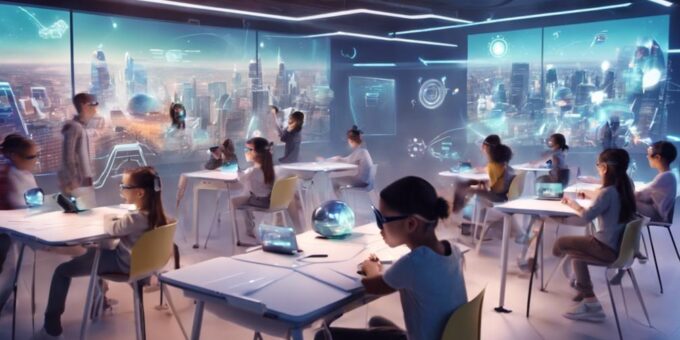
We're on the cusp of a revolution in education, where augmented reality is transforming the way we learn by bringing complex concepts to life, igniting curiosity, and fostering a deeper understanding of the world around us. AR enhances subjects like anatomy, history, and science, and lets educators create customized, interactive lessons. Virtual field trips take us to places like ancient pyramids and Mars, where we can ask questions and collect data in real-time. As we explore AR's possibilities, we're discovering new ways to overcome learning barriers, increasing engagement and motivation to learn. And as we venture further, the future of education unfolds.
AR in the Classroom Today
As we walk into the modern classroom, we're increasingly likely to find teachers leveraging augmented reality (AR) to breathe new life into traditional lesson plans. This innovative technology is transforming the way we learn by making complex concepts more engaging, interactive, and fun. We're no longer confined to static textbooks and one-dimensional lectures. Instead, we're transported to immersive, 3D environments that simulate real-world scenarios, making learning more experiential and effective.
We've seen AR enhance subjects like anatomy, where students can dissect virtual cadavers to explore the human body in unprecedented detail. In history classes, we're able to recreate historical events, allowing us to better understand and empathize with the past. Even math and science become more accessible as AR visualizes complex formulas and concepts, making them more tangible and easier to grasp.
As we adopt AR in the classroom, we're not just changing the way we learn – we're also changing the way we teach. Educators can create customized, interactive lessons that cater to diverse learning styles, making education more inclusive and effective. By embracing AR, we're not just adding a new tool to our educational toolkit; we're revolutionizing the very fabric of education itself.
Interactive Learning Experiences
As we delve into the world of interactive learning experiences, we're excited to discover the innovative ways AR is transforming education. We're going to examine how virtual field trips are revolutionizing the way students explore new environments, and how enhanced engagement tools are making learning more immersive and fun. By incorporating dynamic 3D models, we're about to uncover a whole new level of interactive learning that's both engaging and effective.
Virtual Field Trips Ahead
We're stepping into a new era of interactive learning experiences where virtual field trips are no longer just a novelty, but a legitimate way to explore complex concepts in a more engaging and memorable way. With augmented reality, we can take students on virtual journeys to historical sites, museums, or even outer space, without leaving the classroom. This new approach allows us to transcend geographical and financial limitations, making high-quality educational experiences accessible to everyone. We can explore the ancient pyramids, visit the Great Barrier Reef, or even walk on Mars – all from the comfort of our own classrooms. These virtual field trips are designed to be immersive, interactive, and highly engaging, allowing students to ask questions, collect data, and analyze information in real-time. By leveraging AR technology, we're opening doors to new possibilities, making learning more enjoyable, and fostering a deeper understanding of complex concepts.
Enhanced Engagement Tools
By incorporating augmented reality into our educational toolkit, we're empowering instructors to craft interactive learning experiences that boost student participation, fuel curiosity, and make complex concepts more relatable. We're no longer limited to traditional textbooks and lectures, which often fail to hold students' attention. With AR, we can create immersive experiences that simulate real-world environments, allowing students to explore and interact with virtual objects in 3D space. This level of interactivity encourages students to take an active role in their learning, asking questions, and seeking answers. We've seen students become more engaged, motivated, and invested in their learning outcomes. By making learning more fun and interactive, we're helping students develop a deeper understanding of complex concepts and fostering a love for lifelong learning. As educators, we're excited to see the impact AR can have on student achievement and overall academic performance.
Dynamic 3D Models
In addition to dynamic 3D models, we're transporting students into the heart of complex concepts, where they can dissect, rotate, and explore virtual objects from every angle, fostering a deeper understanding of intricate relationships and spatial awareness. By interacting with virtual objects, students can visualize complex systems and processes, making abstract concepts more tangible and accessible. We're seeing students develop a more intuitive grasp of complex ideas, as they can manipulate and examine 3D models from multiple perspectives. This interactive approach is especially effective in subjects like anatomy, where students can explore the inner workings of the human body in unprecedented detail. Additionally, dynamic 3D models enable students to test hypotheses and explore 'what-if' scenarios in a safe and controlled environment. As a result, we're witnessing a significant increase in student engagement and motivation, as they're empowered to take an active role in their learning journey. By harnessing the power of dynamic 3D models, we're revolutionizing the way students learn and interact with complex concepts.
Enhancing Student Engagement
As we explore the role of augmented reality in education, we're excited to see how it can enhance student engagement. By creating interactive learning experiences, we can encourage students to take a more active role in their learning process. In addition, immersive class environments can stimulate their curiosity and foster a deeper connection with the material.
Interactive Learning Experiences
We're creating immersive learning environments that enable students to delve into the heart of complex concepts, fostering an emotional connection that makes them more invested in the learning process. By leveraging AR technology, we're able to craft interactive learning experiences that are both engaging and effective. We're no longer limited to traditional textbooks and lectures; instead, we're designing simulations, 3D models, and virtual labs that allow students to explore and interact with abstract concepts in a tangible way.
This shift towards interactive learning is having a profound impact on student engagement. Students are more motivated to learn when they're actively participating in the learning process. They're no longer passive recipients of information; they're active explorers, driven by curiosity and a desire to understand. As a result, we're seeing improved retention rates, increased participation, and a deeper understanding of complex concepts. By making learning more interactive and immersive, we're empowering students to take ownership of their education and unleashing their full potential.
Immersive Class Environments
Beyond traditional classroom walls, we're creating immersive environments that transport students into the heart of the subject matter, where they can explore, interact, and absorb complex concepts in a more engaging and memorable way. These immersive class environments are redefining the way we learn, making education more interactive, enjoyable, and effective.
By leveraging AR technology, we're able to craft bespoke learning experiences that cater to diverse learning styles and needs. This leads to increased student engagement, motivation, and overall academic performance. Here are just a few ways we're using immersive environments to enhance student engagement:
- Virtual labs: We're creating simulated lab environments where students can conduct experiments, collect data, and analyze results in a safe and controlled space.
- Historical reenactments: We're transporting students back in time, allowing them to relive historical events, interact with historical figures, and gain a deeper understanding of the past.
- Virtual field trips: We're taking students on virtual excursions to explore exotic destinations, explore new cultures, and develop a broader perspective on the world.
These immersive experiences are revolutionizing the way we learn, and we're excited to see the impact they'll have on the next generation of learners.
Overcoming Learning Barriers
By harnessing the immersive capabilities of augmented reality, we can break down learning barriers that have long hindered student success. For students with disabilities, AR can provide equal access to education, enabling them to participate fully in the learning process. We can create customized learning experiences tailored to individual needs, ensuring that every student has an equal opportunity to succeed.
We've seen how AR can help bridge the gap for language learners, who can practice conversational skills in a virtual environment. It's an opportunity to build confidence and fluency, without the fear of judgment or embarrassment. Similarly, students with learning difficulties, such as dyslexia or ADHD, can benefit from interactive, visual-based learning that caters to their unique needs.
Bringing Textbooks to Life
Exploring the world of augmented reality, our traditional textbooks are transformed into immersive, interactive experiences that make complex concepts more engaging and easier to understand. We're no longer limited to static images and dry text; instead, we can bring diagrams to life, visualize 3D models, and explore interactive simulations. This investigation into passive learning to active engagement has the potential to revolutionize the way we learn.
By incorporating augmented reality into our textbooks, we can:
- Enhance visualization: Interactive 3D models and simulations help us better understand complex concepts, making them more accessible and memorable.
- Increase engagement: Immersive experiences encourage active participation, reducing boredom and increasing motivation to learn.
- Personalize learning: Adaptive AR content can be tailored to individual learning styles, abilities, and pace, ensuring a more effective learning experience.
As we explore further into the world of augmented reality, we're discovering new ways to make learning more enjoyable, interactive, and effective. By bringing textbooks to life, we're not only making learning more fun but also improving comprehension, retention, and overall academic performance. The possibilities are endless, and we're excited to see how AR will continue to transform the education landscape.
Virtual Field Trips Unfold
As we bring textbooks to life, we’re now taking it a step further by virtually stepping out of the classroom, into a world of limitless exploration and discovery. Virtual field trips are transforming the way we learn, and we’re excited to be a part of it. With augmented reality, we can immerse ourselves in immersive journeys to places we might not have been able to visit otherwise. We can explore ancient civilizations, delve into the depths of the ocean, or even walk on the surface of Mars – all from the comfort of our own classrooms. This immersive technology not only enhances education but also makes learning more engaging and interactive. Just as virtual reality in gaming allows players to experience new worlds and scenarios, it now enables students to participate in realistic simulations that deepen their understanding of complex subjects. By integrating these innovations into our lessons, we can make learning more dynamic and accessible for everyone.
These virtual excursions aren't just fun and games; they're also incredibly educational. We can learn about different cultures, historical events, and scientific concepts in a way that's engaging and interactive. We can collect virtual samples, conduct experiments, and gather data in ways that would be impossible in the real world. And with AR, we can do it all in a safe, controlled environment.
The best part? We're not limited by geographical or financial constraints. We can explore anywhere, anytime, as many times as we want. We can even revisit places we've already been to, reinforcing our learning and solidifying our understanding. Virtual field trips are opening up a world of possibilities, and we're thrilled to be at the forefront of this educational revolution.
The Future of Education
We're standing at the threshold of an educational revolution, where augmented reality is reshaping the very fabric of how we learn and interact with information. The future of education is no longer a distant dream, but a tangible reality that's taking shape before our eyes. As AR technology advances, we're witnessing a seismic shift in the way we approach learning.
- Personalized learning experiences: With AR, we can create tailored learning paths that cater to individual learning styles, abilities, and paces. This means that students can learn at their own speed, without feeling left behind or struggling to keep up.
- Interactive simulations: AR enables us to create immersive, interactive simulations that make complex concepts more engaging and accessible. Whether it's dissecting a virtual frog or exploring the inner workings of a volcano, AR brings learning to life.
- Virtual mentorship: AR-powered virtual mentors can provide one-on-one guidance, offering real-time feedback and support to students. This can be especially beneficial for students who require additional support or have unique learning needs.
As we move forward, we can expect to see AR integrate seamlessly into our educational ecosystem. The possibilities are endless, and we're excited to see how this technology will continue to evolve and transform the way we learn.
Frequently Asked Questions
Can AR Be Used for Special Needs Education?
As we step into the domain of special needs education, we're reminded of the wise words of Helen Keller, 'Alone we can do so little; together we can do so much.' Can AR be used for special needs education? Absolutely! We believe AR can be a game-changer, providing personalized, interactive learning experiences that cater to individual needs. By incorporating AR, we can create inclusive, engaging environments that empower students with special needs to reach their full potential.
Are AR Educational Apps Available for All Devices?
We're curious about the availability of AR educational apps across devices. Fortunately, we've found that many AR educational apps are designed to be compatible with a range of devices, including smartphones, tablets, and even desktop computers. We've seen apps that work seamlessly on both iOS and Android, as well as some that are accessible via web browsers. This broad compatibility guarantees that students can access engaging AR learning experiences regardless of the device they use.
How Much Does It Cost to Implement AR in a School?
We're curious about the cost of implementing AR in schools. Honestly, it varies widely depending on the scope of the project and the devices we already have. If we need new hardware, like tablets or smart glasses, that'll add to the expense. We're looking at a range of $5,000 to $50,000 or more, depending on the complexity of the program. It's a significant investment, but we think it'll be worth it to enhance our students' learning experience.
Can AR Be Used for Professional Development of Teachers?
We've seen it work wonders in our own school district, where we used AR to upskill our teachers in new pedagogical methods. For instance, we created an AR experience that let teachers explore a virtual classroom, practicing differentiated instruction strategies. It was a game-changer! We're convinced that AR can be a powerful tool for professional development, helping teachers enhance their skills and stay updated on best practices.
Are There Any AR Education Platforms for Rural Areas?
We're exploring ways to bring cutting-edge tech to rural areas, and it's exciting to find AR education platforms that cater to these communities. We've discovered a few innovative platforms that use AR to enhance learning experiences in rural areas. For instance, platforms like EON Reality and Unimersiv offer immersive, interactive lessons that can be accessed remotely.
